Can seven religions describe the same human longing yet disagree about where it leads?
Imagine placing the Jewish vision of Canaan beside the Buddhist idea of Nirvana. One speaks of covenant and sacred land. Buddhism focuses on ending suffering by letting go of desire. Judaism follows a different path, rooted in faith and God’s covenant.
Reading comparative theology books helps you learn about such differences. You discover what each religion teaches and how people practice their faith. You also see how these beliefs shape their daily lives.
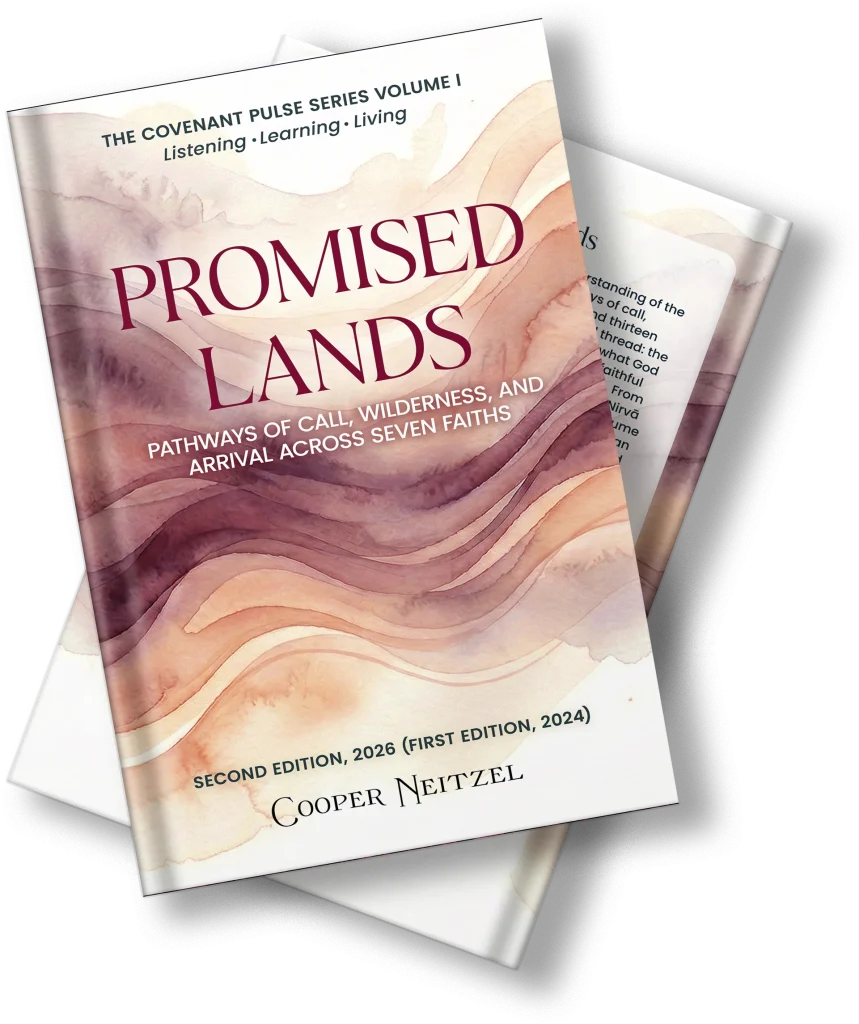
In Promised Lands, Cooper Neitzel examines these questions through seven religious traditions. Rather than treating them as identical, he gives each faith room to explain its own journey.
Reading about one religion can deepen your knowledge. Reading several side by side can change the questions you ask.
For example, Christianity teaches salvation through Jesus Christ. Buddhism teaches liberation through the end of craving. Hindu traditions teach paths toward Moksha, or freedom from rebirth.
All three address human suffering, but their answers are far from identical.
Good books about world religions help readers notice such differences without turning them into arguments.
Neitzel takes this approach in Promised Lands. He compares sacred teachings, historical journeys, and spiritual practices. He also writes from his Latter-day Saint faith while treating the other traditions with care and respect.
The result is a study that welcomes thoughtful disagreement rather than hiding it.
What does arriving at a promised land actually mean?
For some believers, it means reaching a sacred place. For others, it means entering God’s presence or finding freedom within the soul.
Neitzel explores these meanings across seven traditions.
Being one of the religious nonfiction book, it begins with Judaism, Christianity, and Islam.
In Judaism, the promised land begins with God’s covenant with Abraham. The Messianic Age holds hope of restoration and peace, and Canaan is very important.
They refer to the New Jerusalem (Christianity). Christ’s resurrection is the ground for the hope of believers in the new world in which God will live with people.
In Islam, there is a vision of Jannah, which means “paradise”. And the wish to be close to Allah, with beautiful parks and running rivers.
Abraham is the origin of these religions. But their narratives on salvation, on God’s promise and man’s responsibility are different.
Then Neitzel proceeds to talk about Krishna, Buddhism, and Sikhism.
Hindus view Moksha as liberation from the rebirth, death, and birth cycle. The spiritual paths are learning, devotion, meditation, and doing good things for other people.
In Buddhism, Nirvana is the state of no desire and no suffering. The Noble Eightfold Path deals with conduct, mental discipline, and wisdom.
The Realm of Truth (Sikhism) is Sach Khand. Here one can make a connection with Waheguru through devotion and spiritual development, with the blessings of God.
These chapters give readers of comparative religion books a valuable distinction. A sacred destination does not always appear on a map.
Sometimes, the journey concerns a change in how a person lives, thinks, or understands existence.
The final tradition receives a more personal examination.
Neitzel studies seven promised-land accounts from Latter-day Saint scripture and history.
And again he talks about the Israelites going to Canaan, the Jaredites, the City of Enoch, and the family of Lehi. He also speaks of the Mulekites, the escape of the Israelites, and the ongoing Gathering of Israel.
There is a different lesson to be learned from each story about faith, obedience, community, and God’s promises.
Together, they introduce a distinctive idea: the promised land is not simply somewhere believers arrive. It is also something they help build through faithful living.
Readers searching for interfaith studies books often want more than a brief history of major religions. They want meaningful comparisons supported by sacred texts and careful study.
Promised Lands offers something useful to several audiences.
Students of theology can look into what salvation, freedom, covenant, and grace mean in different ways.
Students of religion can read stories in the Bible and learn about the beliefs and practices that give them meaning.
While researching their own religious history, Latter-day Saints can learn how people of other faiths deal with common issues.
Interfaith readers can learn why respectful conversation requires understanding differences, not simply celebrating similarities.
The book also includes a glossary and selected references, making it useful for readers who wish to study particular ideas more closely.
Choosing between books about religious beliefs can be difficult. Some provide broad surveys. Others focus narrowly on a single doctrine.
Promised Lands occupies an interesting place between the two. What does it mean to find the place, purpose, or peace we seek?
Cooper Neitzel does not ask readers to set aside their convictions. Instead, he invites them to listen carefully before drawing conclusions.
If you are exploring comparative theology books that offer substantial study across seven faiths, Promised Lands deserves your attention.
Explore or purchase Promised Lands by Cooper Neitzel and discover how seven traditions understand the long journey toward spiritual fulfillment.
After all, how much more might we understand about our own beliefs by learning what others hold sacred?
Living the Pulse looks at faith, meaning, spiritual growth, and how people change as they go through different stages of life.
The book is for people who are looking for spiritual meaning and answers, as well as people who are skeptical and people who believe.
The P-R-A-Y-E-R Sequence looks at Purpose, Resolve, Alignment, Yield, Embody, and Reflection as spiritual growth steps.
Yes, author Cooper Neitzel looks into seven traditions while keeping their own beliefs, ways of life, and spiritual views.
People can learn how faith affects the choices we make every day, how we think, how we serve, how humble we are, and how we live with purpose.
What takes place after death? Can people get away from pain? What does it mean to really be at peace? These are questions that have been asked for a very long time. That being said, different religions

Can seven religions describe the same human longing yet disagree about where it leads? Imagine placing the Jewish vision of Canaan beside the Buddhist idea of Nirvana. One speaks of covenant and sacred land. Buddhism focuses on