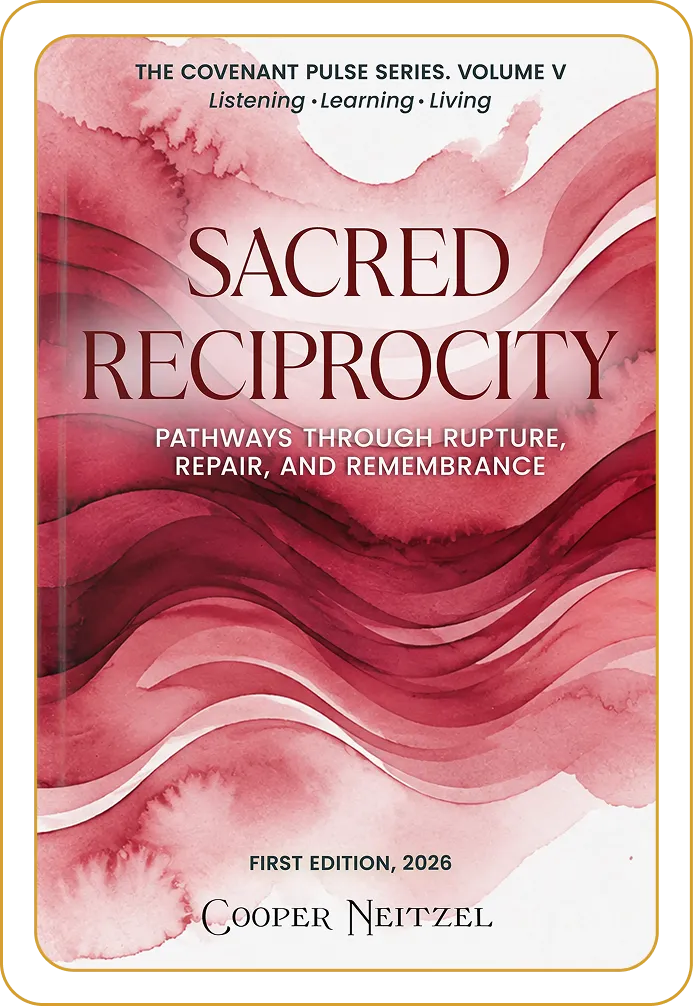
What do we owe the people and places who shaped our lives? In Sacred Reciprocity, Cooper Neitzel invites readers to go beyond gratitude and consider the obligations involved in receiving. He examines relationships to land, ancestors, community, and inherited knowledge through stories of the Whanganui River, Native Nations, and Yorùbá and Ifá worlds. These are not interchangeable stories and Neitzel does not purport to speak for the people who bear them. Instead, he listens to their public records for what they have to say about belonging and obligation. For those who are interested in books about cultural heritage, this fifth volume of The Covenant Pulse Series asks a personal question: now that we know what others have kept alive, what will we do differently?
An estate as a river. Divided homelands of countries. Knowledge fragmented by enforced trans-Atlantic dispersal. In Sacred Reciprocity, these histories are explored without collapsing into a single story of loss. After Cooper Neitzel come four movements: Reciprocity, Rupture, Repair, and Remembrance. He looks first at what people have been given and then asks what was broken, who decides what repair means and what ongoing work keeps gains alive. From the legal recognition of the Whanganui River to Native-led archives and Yorùbá transmission, the book demonstrates why a public declaration is not always the end of the work. Readers of indigenous wisdom books will find particular histories, careful questions, and an invitation to listen without taking the experience of another community and making it their own.
You can respect another community’s history and not change your own habits.” Sacred Reciprocity disrupts this comfortable distance. Cooper Neitzel writes as a Latter-day Saint Christian about how public histories of responsibility, dispossession, repair, and cultural keeping have changed his understanding of his inheritance. It is personal opinion on his part, but the knowledge and authority of the communities is theirs. Among indigenous spirituality books, this one is singular. It does not deliver secret teachings or a ritual manual. It questions what respectful learning has to be, once the book is closed. The earlier series can be read independently of this volume. Start here to thoughtfully reflect on what you have received and what you can responsibly give back.
In Sacred Reciprocity, we explore why gratitude alone is not sufficient, and the ways in which the gifts we inherit come with responsibilities to people, places, and communities.
It looks at the Whanganui River and its people, Native American nations, separate Yorùbá, Ifá, and histories of the African-Atlantic, drawing on published materials.
This book, unlike instructional books on indigenous religions, considers public cultural and historical accounts, while respecting the authority of the communities who maintain their traditions.
Rupture addresses broken relationships, repair addresses work to mend those harms, and remembrance addresses work needed to retain knowledge and lasting change.
It links historical inquiry to reflection, prompting readers to reflect on the possibilities for change in their own lives in regard to their choices, relationships and responsibilities when learning.
I never thought much about how the things we inherit come with responsibilities. This book made me look at that differently.
What interested me most was how the author connected historical events with questions we still need to ask today.
I appreciated how the book explored different communities without treating their experiences as if they were all the same.
The idea that being thankful should change how we act really stayed with me. It gave me something to reflect on.
This book made me think about belonging, memory, and what it takes to preserve something meaningful across generations.