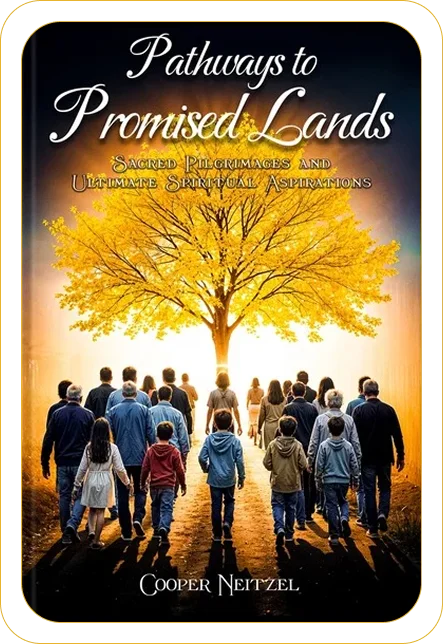
Pathways to Promised Lands looks at why people from all religions travel to holy places. The book looks at how promised lands can stand for both real places and higher spiritual hopes. Cooper Neitzel explores Religion & Spirituality, showing how holy journeys can lead to change, community, and divine guidance. So, people who want to read the best spiritual books can look into how different religions understand pilgrimage and spiritual seeking. Not every journey is the same in this book. Instead, it shows how people want the same things while also finding important differences between them. Among books about spiritual journeys, this book is the perfect place to start for readers.
Pathways to Promised Lands looks at how holy places are described in the world’s major religions. The book talks about the Latter-day Saint heritage, Judaism, Christianity, Islam, Hinduism, Buddhism, Sikhism, and Hinduism. Cooper Neitzel looks at how people connect physical trips with spiritual growth through these practices. At the same time, stories from the past show how travel can change identity, community, hope, and religious practice. This book about spirituality compares different ways of understanding sacred aspiration for people who want to read books about spirituality. It also brings up questions that are studied in Comparative Religion, Religious Studies, and Theology, and it asks readers to think about their own spiritual paths.

Sacred trips often start with a desire to go somewhere, but they rarely stop when you get there. The book Pathways to Promised Lands looks at what happens in the time between those two events. Cooper Neitzel looks pilgrimage as both a way to move and a way to change spiritually in different religions. Along the way, the book talks about how journeys shape who we are, how communities come together, and how we connect with God. This means that readers of religion and spirituality books can learn how holy goals affect how people see their lives. It also makes it possible to look at Pathways to Promised Lands. Along with books about faith and God, connecting Latter-day Saint Studies and more general LDS Studies with comparative research.
This book looks at holy journeys and promised lands from different religions’ points of view, looking at what they mean physically, spiritually, historically, and in terms of change.
Through their ideas about holy journeys, the book looks at Judaism, Christianity, Islam, Hinduism, Buddhism, Sikhism, and the Latter-day Saint tradition.
It links pilgrimage to spiritual growth, community unity, divine guidance, and the deeper goals that shape religious life.
Yes. Readers can think about how different religions see holy places by comparing different points of view in this book.
If you are interested in religious traditions, spiritual journeys, pilgrimage, faith, connecting with God and what the promised lands mean you should read this book.
The book reminded me that spiritual journeys don’t end when you get to the end point. It’s just as important how you change along the way
I liked how the focus was on pilgrimage, community, and divine guidance. It made me think about where I was going spiritually.
Pathways to the Promised Lands changed the way I thought about pilgrimage. The focus on spiritual aspiration was very meaningful to me.
I liked seeing how sacred journeys were looked at in different religions. I was moved to consider what a promised place means to me after reading the book.
Cooper Neitzel makes a deep connection between history, faith, and spiritual growth. The similarities helped me see things in a few different ways.