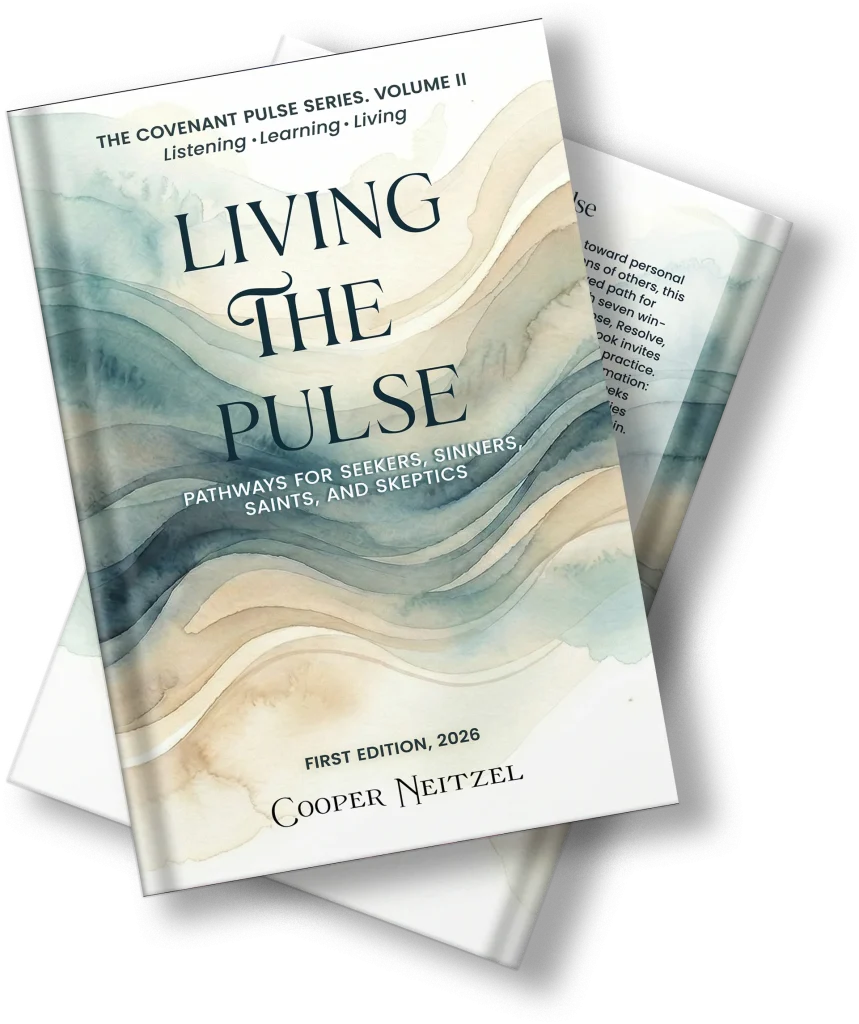
Some seasons make us think about what’s important. Even if we believe deeply, we may still have questions. We might have doubts, but we still need direction. People who read Living the Pulse are already there. Cooper Neitzel shows that faith is not a set of answers but a trip that you can take. The book looks at how people learn, listen, and live as the spiritual seasons change. It provides a useful way for people to find spiritual meaning while still honoring the differences between faith groups.
Living the Pulse does not assume every reader in the same place. It instead sees four starting points: Skeptic, Seeker, Sinner, and Saint. Some Seekers may want to learn more about faith. A Sinner may have to deal with failure, grief, or the need to fix things. Some Saints look for strength before a long spiritual trip. On the other hand, a Skeptic might have doubts and questions.
These times of year can shift. Some people may even have more than one in the same week. So, the book gives you a lot of different ways to grow spiritually. It helps people start with the problems and questions they really have.
The P-R-A-Y-E-R Sequence is what Living the Pulse is all about. It means Goal, Determination, Alignment, Yield, Embody, and Reflection. Each word talks about a step in growing spiritually.
Purpose helps people figure out what’s most important. For the next step, Resolve asks you to make a choice before your feelings get in the way. Then alignment aligns our daily habits with the things we love. Yield is our giving up of our need to be in charge. Live what you believe through relationships, service and everyday life. embodied. Finally, reflection keeps us honest by making us look at things, fix things, and go back to things.
All of these groups make spiritual meaning practical in day-to-day life. They show that our faith gets bigger and bigger by saying the same things over and over.
One thing that makes Living the Pulse one of those spiritual books to read which covers a wide range of topics. The book talks about Islam, Hinduism, Buddhism, Sikhism, the Latter-day Saint Restoration, and Judaism.
Cooper Neitzel, on the other hand, doesn’t say that these cultures teach the same things. He instead hears each religion through its own words and sources. The goal is to understand before you compare. This method makes room for both similarity and difference.
For instance, different traditions may have very different ideas about what it means to surrender. These differences are kept clear in the book. But it also asks what readers can learn from religious practices that aren’t part of their own tradition.
The book isn’t just about faith ideas. Practice takes over instead of the main topic. There are three parts to it: Living, Learning, and Listening. Reading about customs for the first time is different for each person. After that, they look at how people grow spiritually. Lastly, they think about routes that will be useful this time of year.
For this reason, this book will be useful for people who want to read books about spirituality and faith. It connects your thinking to your doing. Also suggests not trying to make things happen quickly but rather taking small, important steps.
Witness cues and “10-Minute” works are also present. Because of these parts, it is easy to think about their spiritual lives in everyday life. That way, the ideas can move off the page and into real life.
Finding spiritual meaning doesn’t always happen in a straight line. Questions come back. Faith changes over time. There is doubt. Failure does happen. But those times can also be opportunities to grow.
You can keep moving through those seasons with Living the Pulse. People who read it don’t have to be perfect before they start. Instead, it says, Pay close attention, learn honestly, live purposefully.
That’s a call for all who are searching for spiritual significance. You don’t have to give every answer today for the trip. To keep asking, to keep learning, and to be willing to live what we find, we need to have courage.
Through the different stages of life, Living the Pulse looks at faith, spiritual growth, and personal change. It helps people move from thinking about things to doing important things every day.
Anyone can read the book—seekers, skeptics, sinners, and saints. It takes into account that people go through these different spiritual stages all through their lives.
The six steps in the P-R-A-Y-E-R Sequence are Purpose, Resolve, Alignment, Yield, Embody, and Reflection. They work together to give us a useful plan for spiritual growth.
Yes. Seven religions are talked about in the book: Judaism, Christianity, Islam, Hinduism, Buddhism, Sikhism, and the Latter-day Saint Restoration. It takes into account their important differences.
The book shows how spiritual knowledge can be used in real life. It tells people to pay close attention, learn with humility, be honest in their thoughts, and live their faith in every day life.
Living the Pulse offers a thought-provoking guide for seekers and skeptics exploring spiritual meaning, deeper questions, purpose, and personal understanding.