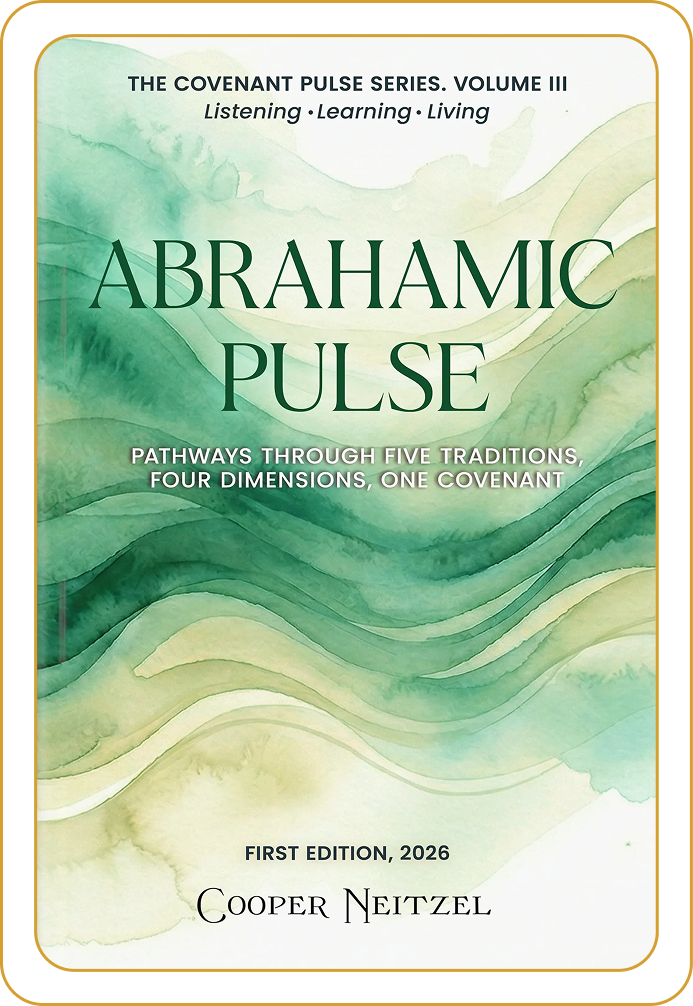
What does God’s promise to Abraham mean for people living thousands of years later? Abrahamic Pulse explores that question through Judaism, Christianity, Islam, the Latter-day Saint Restoration, and the Bahá’í Faith. All traditions trace back to Abraham. Each tradition interprets the covenant differently. In this book, those differences are explored, not by using one faith as the standard for all the others. Neitzel explores how an ancient promise, through scripture, history, and daily religious life, continues to shape how communities pray, belong, and look to the future. It is an invitation to ask deeper questions, and to listen carefully to answers that do not always agree, across generations and cultures. For those readers exploring books about Abraham.
Abrahamic Pulse is built on four questions: What did God promise? Who gets that promise? Where does the covenant grow? And what is its final purpose? These are what Cooper Neitzel calls the four Pulse Dimensions: Promise, Lineage, Land, and Unity. He begins with their origins in the story of Abraham and then gives five religious traditions a voice. He only then compares their teachings. This careful approach is what makes the book different from many books about biblical covenants. Readers encounter Jewish notions of enduring peoplehood, Christian depictions of Christ, Islamic stories of remembrance, Latter-day Saint ideas of restoration, and Bahá’í ideas of unfolding revelation. In lived religious communities, the similarities are important, but the disagreements are important, too.
Faith can connect people without requiring identical beliefs. Cooper Neitzel’s approach throughout Abrahamic Pulse is guided by that insight. Writing openly from a Latter-day Saint perspective, he invites readers to consider other traditions with curiosity and take their differences seriously. The discussion moves beyond definitions to the practices that sustain covenant beliefs: prayer, pilgrimage, family relationships, scripture, and service. This volume, within the context of books on biblical theology, offers a broader comparative perspective with the inclusion of Islamic and Bahá’í perspectives in addition to Jewish, Christian, and Latter-day Saint views. You can start here. You don’t have to have read previous Covenant Pulse volumes. If you want a serious look at Abraham’s ongoing impact, the best biblical studies books provide a good place to begin and ponder.
The book examines the understanding of Abraham’s covenant in five religious traditions, through four major themes: Promise, Lineage, Land, and Unity.
It’s great for readers who like theology, religious history, and biblical studies books that offer an alternative perspective on faith.
Yes. Cooper Neitzel looks at Judaism, Christianity, Islam, the Latter-day Saint Restoration, and the Baha’i Faith in terms of their different beliefs.
The book is written in detailed theological thought and in religious language, but no special knowledge is needed.
Sure. Abrahamic Pulse is the third book in The Covenant Pulse Series; however, it is written in a way that it can be read without the previous books.
I never realized how differently Abraham’s covenant is understood across religions. This book gave me a lot to think about.
What I appreciated most was how the author explained each faith without trying to prove one better than another.
The four themes made it easier to follow the discussion. I especially enjoyed learning how these ancient beliefs still shape people’s lives.
This isn’t a book you rush through. Some parts made me stop, think, and reconsider what I thought I knew.
I picked this up to learn more about Abraham and came away with a deeper appreciation for the different traditions connected to his story.